
On Our Aging Machines

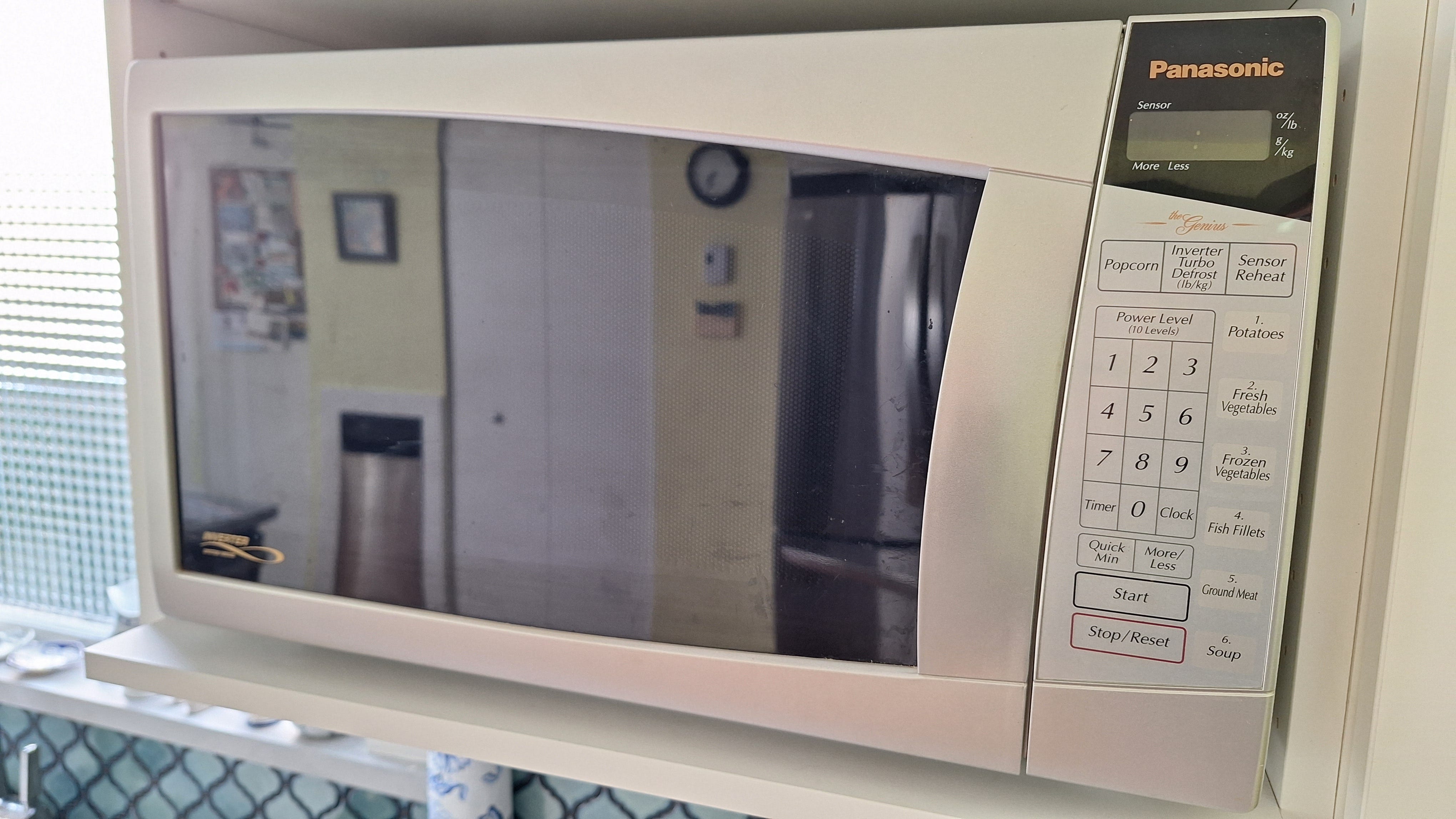
Our bodies, like our twenty-four-year-old microwave, are showing signs of aging. But our microwave is showing us that aging isn’t always a bad thing. The microwave became part of our family when we moved from a townhouse to a house in 2004, and it was in the prime of its life at age two. It put out 1200 watts, and we had to be careful when heating anything, or risk burning our mouths or watching the contents explode all over its walls. Its first health scare came when a friend looked after our cat, and, having never used a microwave, she put a bag of popcorn into it on the popcorn setting, imagining it was sophisticated enough to stop when the popcorn was done. She couldn’t be blamed. The feature was among those below the words “the Genius.” Alas, it was a self-declared genius, and the popcorn caught fire after a few minutes, permanently browning and odourizing the interior. It continued heating as before, and we became accustomed to the burnt-popcorn smell it emitted for many years.
Kitty developed hyperthyroidism at fifteen and made two visits to a “nuclear spa” for radioiodine treatments. She was the only one of us to spend nights in hospital, and she returned diminished each time. We learned that hyperthyroidism is common in aging cats and humans, and that if you walked around a mall with a Geiger counter, you could find a few people undergoing treatment.[i] A few months later, Kitty developed a heart murmur, and about nine months after that, she stopped eating. One eye drooped, its pupil dilated, and the vets euthanized her after she went into shock at the vet’s office. It was the saddest day of my life.
The microwave continued on, and Sarah rescued another cat shortly afterwards. It wasn’t until June 2020 that I began to consider my own age. I went in for new glasses as my presbyopia progressed,[ii] and found that some of my blurry vision was due to my vitreous membrane detaching from my retina—another common age-related rite of passage. Soon after my vitreous membranes detached from both retinas uneventfully (monitored by a retinal surgeon), I noticed curved fingernails and some chest pain when I rode to work. My doctor set me up with a cardiologist, who put me on a statin and aspirin while I waited for an angiogram. While I was waiting for the angiogram, I fractured a sesamoid bone in my foot and tore my Lisfranc ligament while lifting heavy equipment at work.
Guess what that led to. More tests and specialists. I worked with a physiatrist who put me in a walking boot for eleven weeks. An orthopaedic surgeon prescribed shoe inserts the same month I learned I had thyroid nodules requiring annual cancer monitoring. It always seems to come back to the thyroid gland!
Meanwhile, we counted on the microwave to make our morning oatmeal while we replaced our aging gas stove with an electric range. During the month or two of steaming oats and water in the twenty-year-old appliance, we noticed it squealed in the first couple of minutes of heating. We grew accustomed to it and were surprised when it eventually quieted. But along with the silence came curious new behaviours: it lit the food and spun it around for ten seconds before deciding to either start heating it or give up entirely and go dark. That lasted for a few months, and then it rallied, as I did when I finally had my orthotics and could take long walks again.
The microwave entered a period of stable senescence, not unlike my own, where it heated our food reliably after a ten-second pause, though with a little less vigour than it had twenty years earlier. It became a more gentle microwave that didn’t burn or explode anything. And as long as we’re willing to wait a little longer, it keeps up its end of the bargain.[iii] I’ve noticed that I don’t walk as fast as I once did, can’t lift anything heavier than forty pounds without hurting my back, and take a little longer to get up in the morning. My chest pain turned out to be exercise-induced gastroesophageal reflux, which often comes on with aging, and I can avoid it by taking a PPI or exercising less vigorously.
Our bodies are machines, like all the mechanical creations that surround us. Our cells are new when we’re born, and we replace many of the worn-out parts over the decades of our lives. Skin and liver cells are two of our regenerative superstars. Exceptions include our neurons, which dwindle in number from birth onward, and our muscles, including our heart. When those cells die from age or injury, we can’t get them back.[iv] We can adapt to their loss by forming new connections between existing neurons in the brain and by enlarging the remaining muscle cells in our heart and body. Through these mechanisms, we can improve with age.
Our first car was a red 1979 Plymouth Champ that Sarah bought from her brother in 1987. He had hit a deer and replaced a fender, possibly the windshield, but the rebadged Mitsubishi Mirage was known for its reliability. After we towed a U-Haul trailer to Los Angeles, the suspension swayed when we took corners a bit too tightly. It needed several new clutch cables, and the engine caught fire once. After minor repairs, we continued to drive it for seven more years. Eventually, the engine seals gave out, and smelly blue smoke trailed us everywhere we went. At first, we outran the cloud well enough to avoid poisoning ourselves and kept the oil and antifreeze topped up, but when we moved to Seattle and had slightly better jobs, we asked a mechanic for a professional opinion.
Like getting advice from a doctor about an annoying symptom I’ve dragged out for weeks, months, or years, the mechanic examined the fifteen-year-old car and said it was time to consider finding a new one. We could replace the suspension and seals, but it would cost more than it was worth. Fortunately, most doctors I’ve seen so far haven’t delivered such dire news. That is, if you don’t count transitioning as a costly repair. More accurately, it’s been a series of costly repairs, including medications, several surgeries, and a new wardrobe.
For now, everything in my body and the other machines that accompany it tick along predictably. Nutrition, exercise, and regular check-ups with my doctor keep me running as smoothly as can be expected of a machine at the end of its sixth decade.[v] The microwave and I have a running bet on who will outlast the other. Either way, Sarah isn’t planning to replace either of us if we go before her.
Any thoughts? How are you doing? I’d love to chat…
[i] Radioiodine stays in the system for a few days—the friend looking after Kitty had undergone it herself.
[ii] Presbyopia is age-related stiffening of the lens, making it harder for us to focus on nearby objects. It comes from the Greek for “old sight.”
[iii] I measured its wattage, and it draws 900 watts, where it had once been rated at 1320.
[iv] There’s some evidence of neurogenesis in the adult human brain, but to a limited extent. We can’t grow back parts of our brain that have died as a result of stroke or injury.
[v] When Paul McCartney and Neil Young were twenty-four, they wrote songs reflecting on age. Neil wrote his, Old Man, when he met the caretaker of the ranch he bought. Paul McCartney began writing the melody to his song, When I’m Sixty Four, when he was fourteen and finished the lyrics with John Lennon, ten years later, when his father was sixty-four.