
On Realizing Dreams

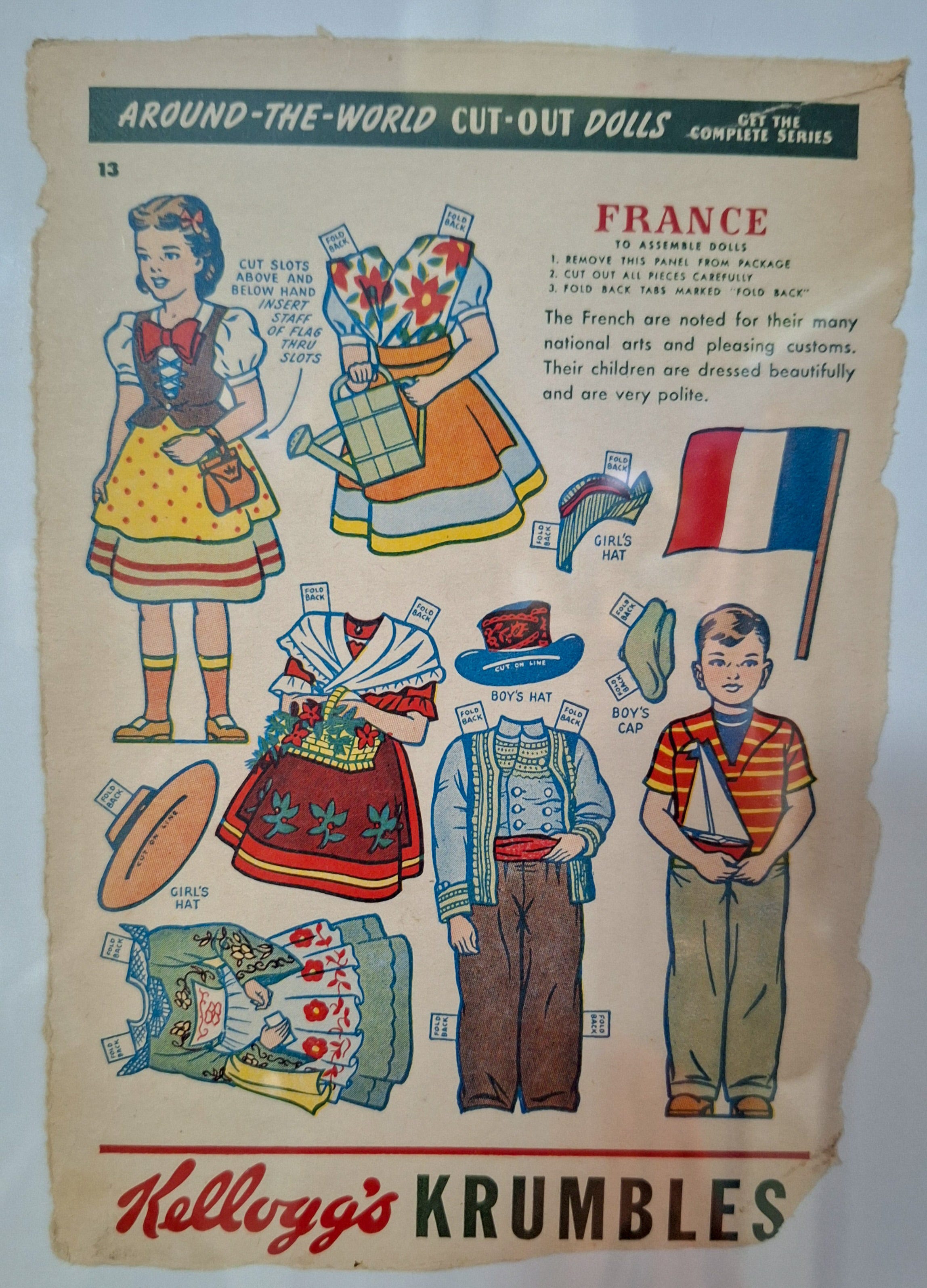
After Sarah’s father died, we cleaned out her family’s home and found a keepsake of her mother’s from 1946. Her mother was eighteen in 1946, and something about the French paper dolls caught her eye. We’ll never know why she kept the “Around-the-World Cut-Out Dolls” from the back of a Kellogg’s Krumbles cereal box, but finding it made me wonder what future she imagined for the cardboard cut-outs and for herself. Was she hoping to collect all the international costumes? Did she dream of having a daughter to give it to? Maybe a trip to France? At eighteen, I was finishing high school and starting university, with dreams of studying biology and getting into med school.
At eleven, I hoped to become a popular singer and prepared by performing in school talent shows and musicals. At twelve, I won an award from the local American Legion for writing, “I will serve the community with my voice.” Then puberty came. My voice dropped into a register that was foreign to me, and I quit singing altogether.
I pivoted to science at fourteen when a junior high science teacher complimented my inquisitiveness and gave me high marks. It was a lower-level science class for students “tracked” out of university prep, and he made me feel like a star. I wasn’t gifted, merely persistent, so Mom helped me find a tutor so I could take a math analysis class one summer. That caught me up academically with my university-bound friends in orchestra, which led me to join the debate team and find success in high school physics. Some were angry when I won the Physics Student of the Year Award based on extra-credit assignments rather than exam scores, but I knew how to impress the teacher with late nights spent solving his puzzles.
Hard work didn’t turn me into a straight-A student in university because I couldn’t write exams to save my life, especially in chemistry. High marks in chemistry were a prerequisite for med school, and rather than find a tutor and retake the courses, I opted to do an honours research thesis, and my advisor nominated me for honours in my Biology degree to help me get into grad school. Again, my exam marks weren’t up to snuff, and he forced the department’s hand, leading to a vote that killed the honors program—making me the last Honors in Biology granted by the university.[i]
When I applied to grad school, a psychology professor interviewing me said that my essay, exam scores, and transcript all pointed to a diagnosis of dyslexia. I laughed it off because it was just weird for him to say that in an interview. I was slow at math, a slow reader, unable to spell even the easiest words, and couldn’t tell left from right, but I’d made it this far and wasn’t about to turn back.[ii]
You know the rest—PhD, postdoc, professorship, pharma, polytechnic instructor, then writing. I didn’t advance because advisors, professors, or supervisors showered me with praise, but because of my interest, dreams, and opportunities.[iii] I didn’t stop dreaming when my voice changed—I dreamed of other things. Falling in love. Challenging my curious mind. Climbing the career ladder. Writing a novel or two. I would enjoy the work and have fun along the way. That’s how dreams work for me.
Research and ancient Hindu scripture back me up. Krishna-Dwaipayana Vyasa is quoted in the Bhagavad Gita as saying, “Those who are motivated only by desire for the fruits of action are miserable, for they are constantly anxious about the results of what they do.” Research suggests that when I visualize only my goal, I’m less likely to achieve it, as if visualizing the outcome short-circuits my will to achieve it. Deadlines do the same thing. When I miss them, I’m more likely to give up entirely. Goals that come with prizes or pay are even worse—they turn something fun into a chore, and I’m more likely to look for a shortcut to get it done.
Having a dream was more important to me than realizing it, because it gave me something to chase and always led to another dream. The joy of playing with paper dolls as a child reminded me in adulthood that I had dreamed of becoming a woman. The memories of visiting France as a teenager reminded me that I had once dreamed of leaving the U.S. to live in another country. Years later, I realized that dream by becoming Canadian. Something as simple as a Kellogg’s Krumbles box can cause ripples that change a life when it sparks a dream.
Any thoughts? How are you doing? Email me…
For a musical pairing, consider Heart’s These Dreams.
[i] They kept the Distinction in Biology award with strict GPA requirements.
[ii] Analogue clocks without numbers are tough. The minute hand is easy, but the hour hand at one, five, seven, and eleven escapes me—sometimes three and nine, too, but sunlight and the passage of time help with those two times. I struggled to learn left from right until I began teaching human anatomy at the age of forty-one. I was tracked out of university prep because I didn’t know my multiplication table in Grade 4. I leaned heavily on spelling and grammar checkers, beginning with the one built into WordPerfect. Writing with a typewriter was like acrobatics without a net, and it’s probably what gave me away when I applied to grad school!
[iii] In fact, some thesis advisors, supervisors, program heads, and students told me I was terrible at what I was doing (e.g., “This is the worst answer to a comprehensive exam question I’ve ever read. How do you expect me to pass you into the PhD program?”). Let’s say my reviews were mixed.